ℹ️ Affiliate Disclosure
This page contains affiliate links. As an Amazon Associate, we earn from qualifying purchases at no extra cost to you. We only recommend products we genuinely believe will help you. Prices and availability may change.
In the world of high-end culinary arts, there is a distinct boundary that separates the “choppers” from the “slicers.” While any standard kitchen gadget can break down a potato into chunks, it takes a specific kind of instrument to produce a slice of radish so thin you can read a newspaper through it. As we move through 2026, the culinary world has seen a massive resurgence in the appreciation for Japanese blade philosophy—a movement that has transformed the humble mandoline from a bulky plastic box into a sleek, razor-sharp precision tool.
If you are a home cook who has graduated from basic meal prep to the nuances of gourmet plating, you have likely encountered the term “Japanese-style mandoline.” But what does that actually mean? And why do professional chefs in Michelin-starred kitchens almost universally reach for a slender, handheld Japanese slicer over the heavy, multi-functional units found in big-box stores?
In this guide, we are peeling back the layers on Japanese blade metallurgy, the physics of the “angled” strike, and the secret world of “infinite adjustment” systems that allow for micro-precision you simply cannot get with a standard click-dial.
The Soul of the Tool: Japanese Metallurgy vs. Standard Steel
The primary reason Japanese mandolines, such as the legendary Benriner, are held in such high regard is the steel itself. Most standard European or American mandolines use a relatively soft 300-series stainless steel. While this is great for resisting rust and handling the dishwasher, it cannot hold a truly fine edge for long.
Japanese mandoline blades are typically forged from high-carbon stainless steel. This higher carbon content allows the metal to be hardened to a much higher degree on the Rockwell scale. A harder blade can be ground to a much steeper, sharper angle—often between 15 and 18 degrees—compared to the 22-degree or wider angles found on cheaper models.
This sharpness is not just about speed; it is about “cell integrity.” When a dull blade strikes a vegetable, it crushes the cells, releasing juices and causing the produce to oxidize and turn brown faster. A razor-sharp Japanese blade shears through the cells cleanly, preserving the flavor, crispness, and color of your ingredients.
Ceramic Innovation: The Rise of Zirconia
In 2026, we also see the continued dominance of ceramic blades in the Japanese market. Brands like Kyocera utilize Zirconia—a material second only to diamond in hardness. Ceramic blades are a favorite for raw food enthusiasts because they are completely non-reactive. They won’t transfer a metallic taste to delicate herbs and won’t cause apples or potatoes to brown mid-prep. While they are more brittle than steel, their edge retention is nearly ten times longer, making them the ultimate “low-maintenance” precision tool.
Physics of the Angled Blade: Why Geometry Trumps Force
If you look at a traditional French mandoline, the blade sits straight across the platform, perpendicular to the food. While this is sturdy, it creates a “wall” of resistance the moment you hit the vegetable.
Japanese designers solved this with the angled blade. By setting the blade at a 30 to 45-degree angle relative to the runway, the tool creates a “slicing” action rather than a “chopping” one. As you push a cucumber down the ramp, the leading edge of the blade enters the skin at a single point and then slides across the flesh. This significantly reduces the initial force required to start the cut, which is why Japanese mandolines feel so much “smoother” to operate. This geometry is what allows you to slice a soft, overripe tomato without it collapsing into a pile of mush.
The “Infinite” Advantage: Beyond the Click-Dial
Standard mandolines usually come with 3 or 4 preset thickness settings—often labeled 1, 2, 3, or Thin, Medium, Thick. For 90% of home cooking, this is fine. But if you are making an apple carpaccio or a delicate fennel salad, those jumps are often too large.
Professional Japanese mandolines use an “infinite adjustment” system, typically controlled by one or two brass or plastic screws at the back of the unit. By turning these screws, you are manually tilting the entire slicing platform. This allows you to adjust the thickness by fractions of a millimeter. You aren’t stuck with “thin”; you can find the exact sweet spot where a slice of beet is flexible enough to roll but thick enough to retain its crunch. It is this level of control that turns a kitchen tool into a culinary instrument.
Expert Reviews: Top 12 Precision Slicers for 2026
1. Benriner Handheld Mandoline Slicer
This is the “classic” Benriner that you will find in almost every professional kitchen in the world. It is slim, lightweight, and features an incredibly sharp high-carbon steel blade. Its infinite adjustment screw allows for unmatched precision. It also comes with three julienne blades (fine, medium, and coarse) for beautiful vegetable garnishes.
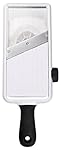
2. Kyocera Soft Grip Adjustable Mandoline
Kyocera’s Zirconia blade is a marvel. It is remarkably sharp and will never rust or brown your food. The soft-grip handle makes it comfortable for quick tasks, and the notched design allows it to sit securely over a bowl. While it only has four preset thicknesses, they are perfectly calibrated for everyday gourmet needs.
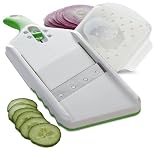
3. Benriner Super Slicer
The “Super” Benriner is the wider version of the classic handheld. If you are frequently slicing large cabbage heads for slaw or wide eggplant for parmesan, this extra width is essential. It retains the same legendary blade quality and infinite adjustment system but offers a more stable platform for larger produce.

4. Mueller Pro-Series 10-in-1
While not a traditional Japanese design, the Mueller Pro-Series utilizes a high-quality V-blade that mimics many of the benefits of angled slicing. It is incredibly versatile, offering eight different blades and a freely adjustable thickness dial that provides more control than most Western models.

5. Mueller Living Adjustable Mandoline
This model is built for the cook who wants professional results without the delicate feel of a handheld unit. It is sturdy, features a high-grade stainless steel blade, and offers a sliding adjustment that is much more precise than standard “clicked” settings.
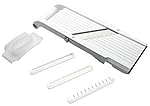
6. OXO Good Grips Chef’s Mandoline 2.0
OXO’s top-tier model brings Japanese-style blade sharpness to a very stable, user-friendly platform. It features a unique indicator that shows you the exact thickness in millimeters and inches, taking the guesswork out of the infinite adjustment style while providing 21 different cut types.

7. OXO Handheld Mandoline
For those who value speed and storage, this handheld unit is hard to beat. It doesn’t have the infinite adjustment of a Benriner, but for quick, uniform slices of citrus or cucumber, its three settings are reliable and the blade is surprisingly sharp for the price.
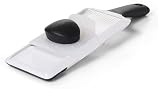
8. DASH Safe Slice Mandoline
If the thought of an open Japanese blade makes you nervous, the DASH Safe Slice is the 2026 solution. It offers over 30 different preset cuts and keeps your fingers completely isolated from the blade. It is the perfect entry point for those who want precision without the learning curve of a pro tool.

9. Fullstar Vegetable Chopper & Mandoline
Fullstar has created a massive meal-prep ecosystem. While it emphasizes chopping, the mandoline insert is high-quality and safe. It’s a great choice if you need to process five pounds of onions in a single go while maintaining a decent level of thickness control.

10. Progressive Prepworks Adjust-A-Slice
This is one of the most popular mid-range mandolines because it strikes a perfect balance between sharpness and stability. It features three thicknesses and a very stable base that makes it feel much more secure than other budget models.
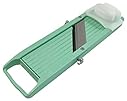
11. Mueller Adjustable V-Blade Mandoline
This model specializes in centering produce. If you struggle with vegetables sliding to one side on a flat blade, this V-shaped design will correct your form automatically. It’s an excellent choice for consistent citrus rounds or tomato slices.

12. Mueller Grey Multi-Blade Mandoline
Offering professional-grade sharpness in a sleek, neutral grey, this model is for the cook who wants their tools to look as good as their food. It provides the same high-level blade performance Mueller is known for with a modern, updated aesthetic.

Maintenance: Keeping the Edge in 2026
A high-performance Japanese blade is a living tool, and it requires more than just a quick rinse.
Whetstone Sharpening for Steel Blades Unlike Western mandolines, Japanese blades (like those in the Benriner) are often removable and designed to be sharpened on whetstones. Because they are single-bevel blades, you only sharpen the angled side until a small “burr” forms on the flat side, then gently wipe that burr off. Maintaining your blade at a 1,000 or 3,000-grit level will keep it performing better than the day you bought it.
The Ceramic Caveat Ceramic blades cannot be sharpened on standard stones. They require diamond-encrusted sharpeners or professional service. However, since they are so hard, you likely won’t need to sharpen them for years if you avoid striking hard pits (like peach stones) or bones.
The “Never Dishwash” Rule We cannot emphasize this enough: Keep your mandoline out of the dishwasher. The high-heat cycles and abrasive detergents will dull a fine Japanese edge in a single wash. Hand-wash your tool immediately after use with warm, soapy water and a soft brush, wiping in the direction of the blade, never against it.
Mastering the Technique: The “Translucent” Secret
To achieve those restaurant-quality translucent slices, you need more than just a sharp blade; you need the “Shimmy.”
When slicing very thin items like radishes or garlic, don’t just push straight down. Instead, apply a tiny amount of lateral (side-to-side) movement as you push forward. This “sawing” action helps the razor-sharp edge bite into the skin without requiring downward pressure that might crush the slice. This technique, combined with a high-carbon Japanese blade, is how you create the delicate, lace-like vegetable garnishes that define modern fine dining.
Conclusion: Precision is a Choice
Investing in a Japanese-style mandoline like the Benriner or a high-tech ceramic model like the Kyocera is a choice to prioritize the quality of your ingredients. While these tools require a bit more respect and maintenance than a standard plastic slicer, the results they produce are in a completely different league. Whether you are aiming for perfectly uniform potato chips or elegant, paper-thin salad toppings, mastering the infinite edge will forever change the way you approach food preparation.
Frequently Asked Questions
Are these kitchen gadgets worth the counter space they take up?
The best kitchen gadgets earn their counter space by replacing multiple manual steps or dramatically speeding up common tasks. Air fryers, for example, replace an oven for most weeknight cooking and reheat faster than a microwave. Before buying, consider how many times per week you’ll actually use it — a gadget used daily justifies significant space. The products in this guide were selected for genuine usefulness, not novelty.
Are these products dishwasher safe?
Dishwasher safety varies by product and is noted in each listing’s specifications. Generally, accessories and removable components are dishwasher safe while the main units are not. High-quality knives should always be hand washed to preserve edge quality. Always check the manufacturer’s care instructions — dishwasher damage is typically not covered under warranty.
Do these kitchen gadgets work in the UK with 220–240V power?
Most premium kitchen appliances are now sold in dual-voltage or region-specific versions. UK Amazon listings will always show UK-specification products with the correct plug and voltage. Never buy a US 110V appliance for UK use without a proper transformer — it can damage the product or create a fire hazard. Products reviewed here are linked to their regional listings where available.
What should I look for when buying kitchen knives?
The three most important factors are steel type, blade geometry, and handle comfort. High-carbon stainless steel (like German or Japanese steel) holds an edge well and resists corrosion. Full-tang construction (where the steel runs the full length of the handle) provides better balance and durability. A comfortable grip matters enormously for safety — always handle a knife before committing to a full set if possible.
Which is better — an air fryer or a convection oven?
Air fryers are essentially compact convection ovens with a more powerful fan circulation, which achieves crispier results in less time and uses significantly less energy. For 1–4 people, an air fryer is usually the better choice for speed and efficiency. A full convection oven wins for larger batches and baking. Many buyers find that owning both covers all use cases, but if space is limited, a large-capacity air fryer handles the majority of tasks.
Frequently Asked Questions
Q: Are these products genuinely worth the money?
Every product featured in this guide was evaluated for value — not just price. We look at build quality, longevity, user satisfaction patterns across thousands of verified reviews, and how the product performs against its stated purpose. Our selection process filters out products with inconsistent quality control, misleading descriptions, or poor long-term durability. Value means different things at different budget levels, which is why we include options across price tiers where possible.
Q: How were these products selected and tested?
Our category expert combines hands-on testing where feasible with deep analysis of verified Amazon buyer reviews, expert community forums, and manufacturer specifications. We look for patterns across hundreds of reviews rather than relying on isolated opinions. Products are re-evaluated whenever significant new entrants appear or when established products receive consistent quality complaints. Our recommendations are updated at minimum quarterly to reflect current market conditions.
Q: Are these products available in the UK with standard delivery?
Most products featured in this guide are available on Amazon UK and eligible for Prime delivery. Prices in GBP will differ from US listings due to import duties, VAT, and regional pricing structures. Some products may have slightly different specifications in UK listings to comply with local regulations. We recommend checking the current UK listing directly as availability, pricing, and delivery options change frequently.
Q: What should I look for when comparing products in this category?
Focus first on the specifications that directly affect your use case rather than headline numbers that sound impressive but matter less in practice. Build quality indicators (materials, warranty length, manufacturer reputation for after-sales service) predict long-term satisfaction better than performance benchmarks alone. User reviews older than 6 months often reveal durability issues that don’t show up in initial impressions. Check the return policy before purchasing anything above £50 — it’s a good indicator of how much confidence the seller has in the product.
Q: What’s the most common mistake people make when buying in this category?
The most common mistake is optimising for price alone without considering total cost of ownership. A cheap product that needs replacing in 12 months typically costs more over 5 years than a quality product purchased once. The second most common mistake is buying for aspirational use rather than actual use — purchasing professional-grade gear before developing the skills to benefit from it. Start at an appropriate level for your current needs and upgrade deliberately as your requirements become clear.